629
Active businesses (04-11-2026)
GraydonCreditsafe Sector Insight 2026 - Packaging
How is the Belgian packaging sector evolving, and how financially resilient are its businesses? In this GraydonCreditsafe Sector Insight, we analyse trends in the sector, the number of bankruptcies, creditworthiness, payment behaviour and the ability of Belgian packaging companies to withstand financial shocks. Would you like to explore the figures behind this analysis in greater depth? Request the available detailed data and breakdowns.
04-11-2026
To define the scope of the sector, we selected Belgian businesses that manufacture packaging materials and packaging machinery, wholesalers of packaging machinery and weighing equipment, and companies that provide packaging services for third parties.
The analysis is based on selected NACE-BEL codes and was carried out on 4 November 2026.
Between 2015 and 2025, the number of active businesses in the sector covered by this analysis rose from 541 to 581, representing an increase of 7.4%.
However, this growth was not consistent. In 2021, the number of active businesses peaked at 606. It then gradually declined to 581 in 2024, remaining unchanged in 2025.
Although the sector recorded modest growth over the period as a whole, the latest historical figures suggest stabilisation following several years of decline.
Over the past eleven years, the number of new businesses fluctuated between 22 and 46 per year. After reaching a low of just 22 in 2023, the number rose again to 27 in 2024 and 34 in 2025.
At the same time, business closures increased. In 2025, 46 businesses ceased trading, compared with 34 the previous year. This was the highest number of closures recorded during the period under review.
Notably, business closures have outnumbered new businesses every year since 2022. In 2025, 12 more businesses closed than were established.
Want more insights into the sector?

Please note: Bankruptcies are also included in the business closure figures.
The number of bankruptcies also increased sharply in 2025. With 19 bankruptcies compared with 10 in 2024, the figure almost doubled. It was also the highest number recorded between 2015 and 2025.
Bankruptcies accounted for just over 41% of all business closures in 2025, compared with approximately 29% the previous year.
However, bankruptcies were not evenly distributed across the different activities within the sector. Of the 19 bankruptcies in 2025, 14 involved companies providing packaging services for third parties.
Of the 19 bankruptcies in 2025, 14 involved companies providing packaging services for third parties.
This concentration is not an isolated occurrence. Over the entire period from 2015 to 2025, this activity accounted for 92 of the 125 bankruptcies recorded in the sector, or almost 74%. A striking proportion, given that these companies represent only 44% of the businesses in the sector.
The historical figures show how the packaging sector has evolved over the past decade. But what does the sector look like today?
According to the latest available data, as at 4 November 2026, the packaging sector covered by this analysis comprises 629 active businesses.
This current snapshot is based on a different database from the historical analysis. Due to differences in how company data is recorded and processed, the two datasets are not directly comparable.

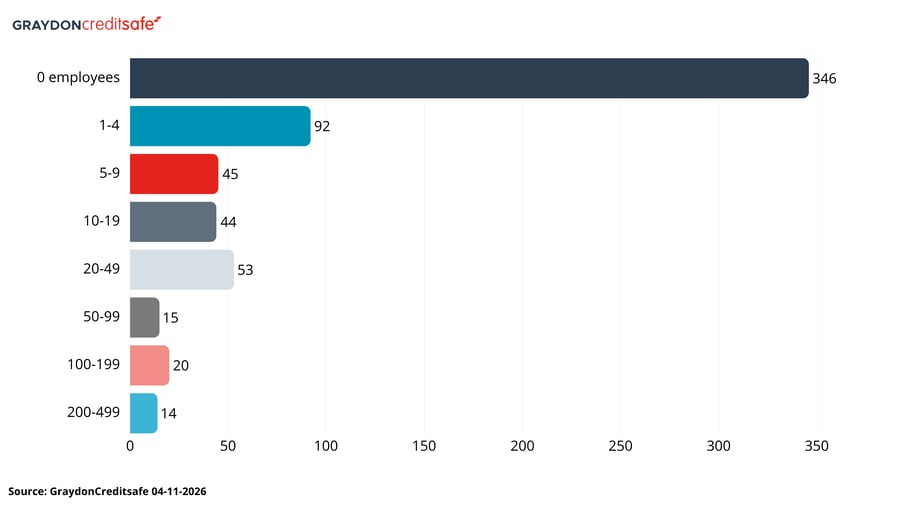
The GraydonCreditsafe risk score provides insight into businesses' creditworthiness and their risk of financial difficulties. The higher the score, the lower the risk of business failure.
Of the 629 active businesses in the packaging sector covered by this analysis, 530 (84.3%) have a calculable risk score. The remaining 99 businesses have a legal structure for which annual accounts are not available in Belgium, for example because they operate under foreign law. Where applicable, their scores are only calculated in an international context. They are therefore excluded from this analysis.
Breakdown by risk score – 530 businesses with a calculable risk score

Score 0-29
6,6% - 35 businesses
High risk
Score 30-59
39,2% - 208 businesses
Mid-range
Score 60-100
54,2% - 287 businesses
Low risk
Of the 530 businesses assessed, more than half (54.2%) have a risk score of at least 60. A further 39.2% fall into the middle category, with scores ranging from 30 to 59.
A smaller group of 35 businesses (6.6%) have a risk score below 30. These businesses fall into the highest risk category and are more financially vulnerable.
Approximately one in fifteen businesses with a calculable risk score falls into the highest risk category. For companies doing business with this sector, this is an important consideration when assessing new and existing business partners.
The GraydonCreditsafe payment score provides insight into businesses' payment behaviour. The higher the score, the more promptly a business pays its invoices.
Of the 629 active businesses in the packaging sector covered by this analysis, 279 (44.4%) have a calculable payment score. For the remaining 350 businesses (55.6%), no payment score could be calculated because payment behaviour data was unavailable. They are therefore excluded from this analysis.
Breakdown by payment score – 530 businesses with a calculable payment score

Score 1-2-3-4
8,2% - 23 businesses
Poor payment behaviour
Score 5-6-7-8
15,8% - 44 businesses
Average payment behaviour
Score 9-10
76,0% - 212 businesses
Good payment behaviour
Of the 279 businesses assessed, 212 (76.0%) achieve a payment score of 9 or 10. This indicates generally prompt payment behaviour within this group.
A further 44 businesses (15.8%) fall into the middle category, while a smaller group of 23 businesses (8.2%) have a low payment score.
Approximately one in twelve businesses with a calculable payment score falls into the lowest score category. This highlights the importance of understanding the payment behaviour of business partners.
A financially healthy business is not necessarily able to withstand unexpected economic shocks. The GraydonCreditsafe Resilience Indicator provides insight into the financial reserves businesses have available to absorb such shocks, beyond what is required for their normal operations.
Shock resilience could be calculated for 507 of the 629 active businesses (80.6%). The remaining 122 businesses (19.4%) are excluded from this analysis.
Of the 507 businesses analysed, 129 (25.4%) fall within the green zone. They combine good financial health with high resilience to shocks. Approximately half (50.7%) fall within the yellow zone, while almost a quarter (23.9%) are in the red zone.
Notably, 114 businesses are financially healthy (segments 3+ and 3-) but remain vulnerable to shocks. This represents almost one in three of the financially healthy businesses included in this analysis.
Almost one in three financially healthy packaging businesses is insufficiently resilient to shocks. This finding comes from a GraydonCreditsafe analysis of 507 businesses.
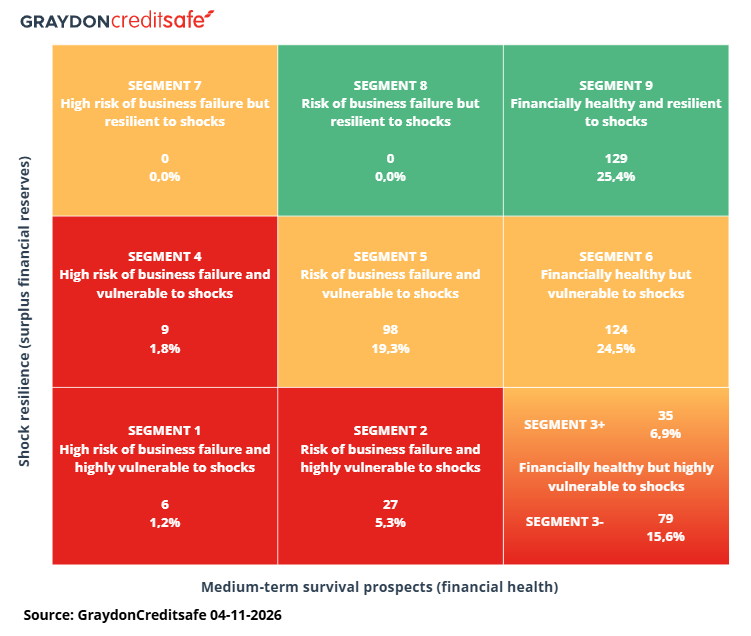
A favourable financial position therefore does not automatically provide sufficient protection against unexpected events. This highlights the importance of shock resilience as an additional indicator when assessing business relationships.
The Belgian packaging sector is facing significant changes. Stricter environmental regulations, the transition to circular packaging and fluctuating raw material and energy prices are putting businesses under pressure. At the same time, automation, more flexible production processes and changing customer expectations require further investment.
These developments affect the entire packaging supply chain, from material manufacturers to machinery producers and packaging service providers. But what do these challenges mean for businesses working with this sector?
The new EU Packaging and Packaging Waste Regulation (PPWR) introduces stricter requirements for recyclability, material use and reuse. Packaging companies must adapt their products, production processes and business models accordingly.
This transition brings investment requirements and financial uncertainty. Our analysis of shock resilience shows that a sound financial position does not automatically mean a business is sufficiently resilient to unexpected shocks.
For businesses that depend on packaging suppliers, financial resilience is therefore an important consideration when assessing their business partners.
Fluctuating raw material and energy prices are putting pressure on profit margins. At the same time, automation, shorter production cycles and more flexible production lines require additional investment.
This combination can limit businesses' financial flexibility and affect their liquidity and payment obligations.
For suppliers, lenders and other business partners, it is therefore important to identify changes in creditworthiness and payment behaviour at an early stage. Continuous monitoring highlights changes in businesses' financial risk profiles, enabling them to adjust their credit decisions accordingly.
The packaging sector is heavily dependent on raw materials, specialised suppliers and interconnected production processes. Supply disruptions or financial difficulties affecting one link in the chain can have consequences for the entire supply chain.
The transition to more sustainable packaging also creates new partnerships, for example with suppliers of recycled materials and innovative packaging technologies.
This makes thorough assessments of existing and potential business partners, both in Belgium and internationally, even more important. With up-to-date international company information and continuous monitoring, you can identify financial risks and track potential changes affecting your suppliers.

The Belgian packaging sector has a relatively stable number of businesses, but this overall picture masks significant differences. Bankruptcies are concentrated in certain activities, and a sound financial position does not automatically provide protection against economic shocks.
At the same time, the sector faces changes that require investment and adaptability. The financial resilience of individual businesses is therefore becoming an important consideration for anyone doing business with this sector.
About this analysis
This GraydonCreditsafe Sector Insight is based on company data covering Belgian businesses operating in selected NACE-BEL activities within the packaging sector.
The historical analysis covers the period from 2015 to 2025. The number of active businesses reflects the situation as at 31 December of each year. New businesses, business closures and bankruptcies are recorded by calendar year. Bankruptcies are included in the business closure figures.
The current figures represent a snapshot as at 4 November 2026. As the historical and current figures are drawn from different databases, the two populations are not directly comparable.
The analyses of creditworthiness, payment behaviour and shock resilience include only businesses for which the relevant indicator is available. The size of the study population is specified separately for each analysis.