Tariff Chaos: Squeezed Margins, Fraud, Recession?

Get stats and insights from our latest research study

3 Mins
09/07/2025

The word ‘tariffs’ is extremely charged right now. It’s all anyone can talk about – and we get it. There’s been a lot of uncertainty, confusion and panic since the U.S. administration started talking about raising tariffs. 

Both sides of the coin – customers and suppliers – are feeling the pain in their own unique ways. On one side, you’ve got customers (i.e. U.S. companies who are importing goods from other countries. For these companies, the recent tariff hikes will lead to higher costs and could create supply chain disruptions that hurt the bottom line. 

Negative financial planning under tariffs

And on the other side, you’ve got suppliers (i.e. companies in other countries who are responsible for manufacturing and shipping goods to customers in the U.S.). The financial health and cash flow of these companies depends a lot on whether their customers continue to work with them. So, if customers pause orders or cancel contracts, suppliers could struggle to keep their businesses running long-term. 

Because of how much is at stake with tariffs, today we launched our research study, Tariff Risks in the Supply Chain, which uncovers the impacts of tariffs on businesses and how prepared businesses currently are. So, let’s dig into a few of the findings that really caught my attention. 


U.S. imports are likely to plunge, increasing the risk of a global recession

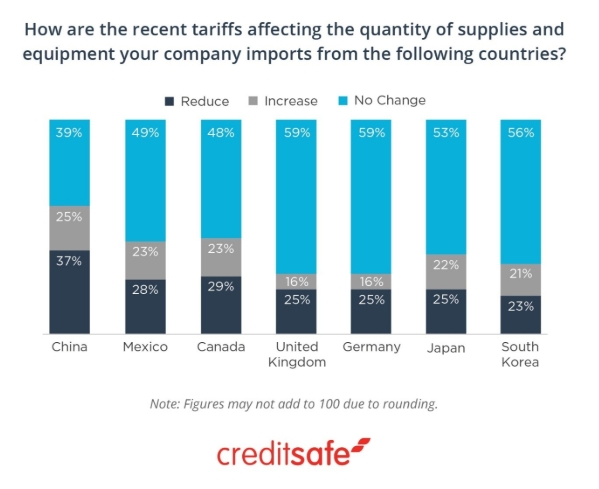
As our study reveals, U.S. businesses plan to import fewer goods from countries like China, Canada, Mexico, the United Kingdom, Germany, Japan and South Korea. For example, 37% of the respondents plan to reduce the quantity of goods they import from China, 28% of the respondents will import fewer goods from Canada and 28% of the respondents plan to import fewer goods from Mexico. 

Creditsafe stats on tariffs

On top of this, 47% of the respondents said the recent tariffs have led them to look for alternative suppliers in new countries. But it’s not as easy as just saying – ‘hey, we need to find new suppliers in countries with lower tariffs.’ The main reason these companies are looking for new suppliers is to avoid paying higher tariffs. While cost is certainly an important factor in the decision, there are many other things you need to consider before signing a contract with any new suppliers. Like what, you might be asking? 

You don’t want to do all the work of finding new suppliers in countries with lower tariffs only to find out the new suppliers are heavily cash-strapped and lost several large contracts in recent months. If they don’t have enough income and cash flow to source materials and equipment for your orders, pay workers and ship your orders in full and on time, all that work you did will be futile. Your supply chain will likely take the hit – with delayed or cancelled shipments, frustrated customers and potentially impacted revenue if customers go elsewhere. Definitely not an ideal situation, right? 

The way to avoid this is to do a thorough review of the business credit reports for every new supplier you’re considering adding into your global supply chain. You need to pay close attention to a few things, including how late they typically pay their suppliers, what percentage of bills are falling into the excessively late categories (91+ days late), their credit limit and if it’s dropped significantly in recent months, the number and cost of legal filings, among other information.

3 in 4 businesses anticipate a rise in trade fraud

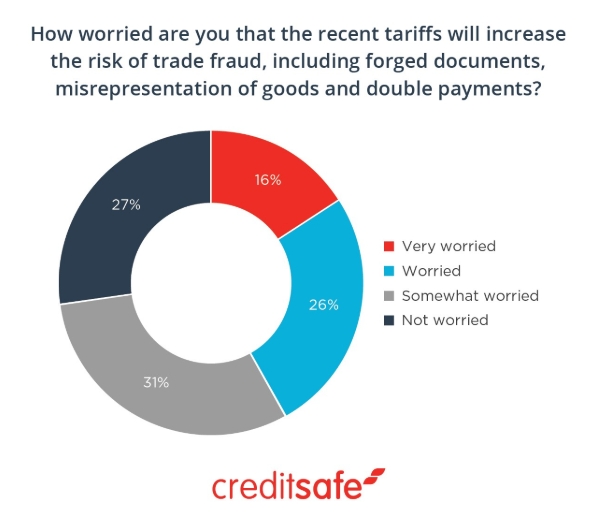
One of the more shocking findings from our study is that 73% of U.S. businesses are worried (to some degree) that higher import duties will drive an uptick in forged documents, mislabeled goods or duplicate payments. But then I was reading a recent article in the New York Times and I wasn’t so surprised anymore. 

Creditsafe fraud under tariffs chart

The New York Times article had actual emails sent from Chinese suppliers to U.S. importers – all claiming in one way or another to dodge high tariffs. One such email said, “We can avoid high duties from China, which we have already done in the past.” Another email claimed it could cap the tariffs at a flat 10% rate. It’s likely that these promises of ‘beating the tariffs’ are based on suppliers falsifying information about the shipments or moving their goods to another country with a lower tariff rate before shipping to the United States. 

Given how bold some suppliers are being about creatively dodging tariffs, it’s good to see that nearly half (47%) of the respondents plan to be more diligent about verifying the legitimacy of suppliers they use in the next 12 months. And if you’re thinking, ‘What’s the big deal? Do I really need to be more diligent about verifying the legitimacy of suppliers?’ Let me answer that for you – yes, yes you do. 

There are some things you can do to avoid being caught up in trade fraud. When you look at the business credit reports of your suppliers, you should verify the company ownership. Make sure the people you’re speaking to are officially associated with the company. You also should double-check the headquarters and branch locations are all accurate as they appear in the business credit reports for the company. Another thing you can check is the company structure and stakeholders. Of course, you shouldn’t just limit yourself to reviewing these things. Make sure to do a thorough review of all shipping and customs documents. Look out for forged documents as well as mislabeled quantities, materials and countries of origin. These are some of the things a supplier might try to do to keep import duties lower for you – so they can retain your business. But the cost savings won’t be worth it if you end up in legal and compliance trouble.

Could a tariff-fueled global recession be on the horizon?

But what’s especially worrying is that the tariff hikes aren’t just causing financial and supply chain chaos for businesses. A whopping 84% of businesses believe that the recent tariffs are likely (to some degree) to increase the risk of a global recession in 2025. This might seem like an irrational thought process to some, but it really isn’t. 

Economists from J.P. Morgan have estimated there’s a 40% probability of a tariff-induced recession this year. Meanwhile, the International Monetary Fund (IMF) has lowered its U.S. growth forecast for 2025 from 2.7% to 1.8%. Although the IMF’s forecast suggests a global recession is unlikely in 2025, it raised the likelihood of a recession to 40% - up from 25% in its previous outlook. 

This is just the tip of the iceberg in terms of what our study found out about how tariffs are affecting businesses. To get all the juicy stats, you can download the full report.

Diversifying your suppliers due to tariffs?

Do your due diligence with Creditsafe first.

Required field! Please enter at least 3 characters! Special characters are not allowed!
Required field! Email address is invalid! Email address is invalid!
Required field! Please enter at least 3 characters!
Required field! Phone number is invalid!
Please select an option! Required field! Please enter at least 3 characters!
Spinning Loading Circle
Mark Laube

About the Author

Mark Laube, Product Director, North America, Creditsafe

Mark Laube has over 8 years of leadership experience and deep expertise in business credit data, financial data integration, and evolving market needs. As Product Director, North America, Mark drives the strategic direction of Creditsafe’s product suite with a focus on innovation and trusted solutions. His role demands a high level of authority in navigating the business credit and risk landscape, and his insights are instrumental in shaping product developments that businesses can trust.

Chapter 1

Related articles...